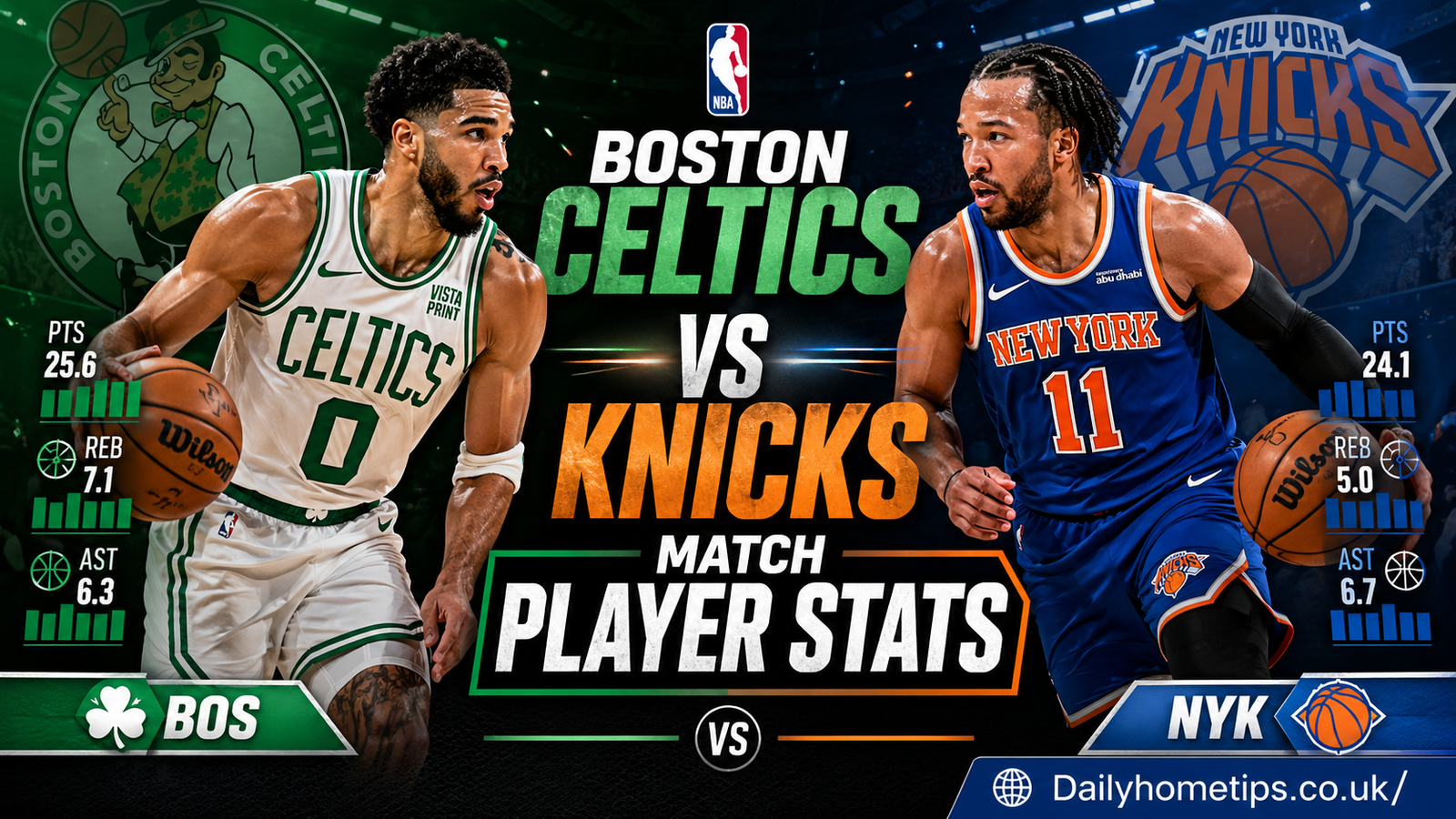
Boston Celtics vs Knicks Match Player Stats tell the story of a close Eastern Conference battle shaped by late-game execution, star power, and timely shooting. The New York Knicks defeated the Boston Celtics 112-106 on April 9, 2026, at Madison Square Garden, with a strong fourth quarter giving New York the final edge. ESPN’s box score shows the Knicks outscored Boston 31-23 in the final period, which became the decisive stretch of the game.
This matchup had everything NBA fans expect from Celtics vs Knicks basketball: physical defense, clutch scoring, smart passing, and pressure possessions. Josh Hart led the Knicks with 26 points, Jalen Brunson added 25 points and 10 assists, while Jayson Tatum carried Boston with 24 points, 13 rebounds, and eight assists. The game was close enough that every rebound, turnover, and three-point shot mattered in the final result.
Match overview
The Knicks entered this game with urgency because they were still fighting for a higher Eastern Conference position. Boston, meanwhile, came into Madison Square Garden with a strong record and enough depth to challenge New York even without every key player available. The final score of 112-106 reflected a game where neither side fully controlled the night for long stretches.
Boston started well and led 29-26 after the first quarter, but New York responded by winning the second quarter 28-24 and taking a 54-53 lead into halftime. The Celtics regained momentum in the third quarter and led 83-81 entering the fourth, but the Knicks closed harder, scoring 31 points in the final period. That late push turned a tight contest into a valuable New York win.
Why this rivalry matchup mattered
The Celtics and Knicks are two of the NBA’s most historic franchises, and games between them usually attract attention beyond the normal regular-season schedule. Their meetings carry rivalry value, playoff implications, and strong fan interest because both teams represent major basketball markets with passionate supporters. That makes every box score more meaningful for fans, analysts, and fantasy basketball players.
This game mattered even more because the Knicks were trying to stay alive in the race for the No. 2 seed in the East. Reuters reported that New York could still catch Boston and finish as high as second in the Eastern Conference standings after this win. That context made the late-game performance from Hart, Brunson, and Towns more important than ordinary regular-season numbers.
Full box score story
The full box score shows a strong contrast between Boston’s volume shooting and New York’s efficiency. Boston made 38 of 84 field goals, shot 16 of 43 from three-point range, and hit 14 of 16 free throws. New York made 43 of 80 field goals, shot 15 of 35 from deep, and converted 11 of 15 free throws. The Knicks shot 54 percent from the field compared with Boston’s 45 percent.
Boston won the rebounding battle 42-30, but New York balanced that weakness with better shooting, more assists, and stronger late execution. The Knicks finished with 29 assists compared with Boston’s 23, showing cleaner ball movement in key possessions. Boston also had 10 turnovers, while New York had seven, and those small differences became important in a six-point game.
Boston Celtics player stats breakdown
Boston Celtics vs Knicks Match Player Stats show that Jayson Tatum delivered the best all-around line for Boston. He finished with 24 points, 13 rebounds, eight assists, one steal, and one block in 40 minutes. Although his shooting was difficult at times, his rebounding and playmaking helped Boston stay competitive throughout the night. His line reflected both star responsibility and the defensive attention he faced.
Payton Pritchard gave the Celtics an important scoring lift with 23 points and six assists, shooting 10 of 20 from the field. Baylor Scheierman was one of Boston’s most efficient players, scoring 20 points on 7-of-8 shooting and making 6 of 7 three-point attempts. Neemias Queta added 10 points and 10 rebounds, giving the Celtics interior energy and second-chance opportunities.
New York Knicks player stats breakdown
The Knicks were led by Josh Hart, whose scoring shaped the final result. Hart scored 26 points on 10-of-15 shooting and made 5 of 7 shots from three-point range. His most important work came late, as Reuters reported that he scored 15 of his 26 points in the fourth quarter and hit two three-pointers in the final minute.
Jalen Brunson added the control New York needed at point guard. He scored 25 points, handed out 10 assists, and committed only one turnover in 37 minutes. Karl-Anthony Towns added 16 points, 12 rebounds, and four assists, giving New York a valuable frontcourt presence. Mikal Bridges also played an efficient role, scoring 10 points on perfect 4-of-4 shooting with six assists.
Top performers of the game
Josh Hart was the most decisive performer because his fourth-quarter shot-making directly changed the outcome. His five made three-pointers gave New York spacing, rhythm, and confidence when Boston threatened to take control. In a game decided by six points, Hart’s late threes were not just highlight plays; they were winning plays that separated the Knicks from the Celtics.
Jayson Tatum was Boston’s most complete performer, even in defeat. His 24 points, 13 rebounds, and eight assists showed how much of Boston’s offense ran through him. Brunson also deserves major credit because his 10 assists kept New York organized and helped teammates get quality looks. Towns, Pritchard, and Scheierman rounded out the group of players whose stats strongly shaped the game.
Quarter-by-quarter analysis
The first quarter belonged slightly to Boston, which scored 29 points and created early rhythm. Tatum was active as a scorer and facilitator, while the Celtics’ spacing allowed them to test New York’s defense. The Knicks stayed close with balanced scoring, and the 29-26 score after one quarter showed that neither team had established full control.
The second quarter changed the pace. Reuters reported that a 10-0 Knicks run gave New York a 33-29 lead, and the Knicks eventually entered halftime ahead 54-53. Boston responded in the third quarter and led 83-81 after three, but New York’s 31-point fourth quarter became the biggest scoring period of the night and decided the game.
Fourth-quarter turning point
The fourth quarter was the heart of this game. Boston led 92-85 after a Tatum three-point play, but New York answered with seven straight points to tie the score. That response showed the Knicks’ composure under pressure and prevented the Celtics from turning a small lead into a game-winning run.
Hart then became the main closer. Reuters noted that Boston was within three points after a Nikola Vucevic basket with 35.6 seconds left, but Hart made a three-pointer with 15.2 seconds remaining to stretch the Knicks’ lead to six. That shot effectively sealed the game and turned Hart’s night into the headline performance.
Shooting performance and efficiency
New York’s shooting efficiency was one of the clearest reasons for the win. The Knicks made 43 of 80 field goals for 54 percent and hit 15 of 35 threes for 43 percent. Boston was not poor from deep, making 16 threes, but the Celtics needed 43 attempts to get there and finished at 37 percent from long range.
The difference was shot quality and conversion in pressure moments. Hart shot 10 of 15 from the field, Bridges made all four of his shots, and Brunson controlled the offense well enough to keep the Knicks from forcing too many bad possessions. Boston had strong shooting from Scheierman, but several key attempts late did not fall.
Three-point shooting impact
The three-point line played a major role for both teams. Boston actually made one more three-pointer than New York, finishing with 16 threes compared with the Knicks’ 15. However, New York was more accurate from deep, shooting 43 percent while Boston shot 37 percent. That percentage gap mattered because the game stayed tight until the final minute.
Baylor Scheierman’s performance was a bright spot for Boston. He made 6 of 7 three-pointers and nearly helped rescue the Celtics with his efficiency. Hart matched that impact on the Knicks side by making 5 of 7 from deep, including late shots that carried far more pressure. His timing made his three-point line even more valuable than the raw number alone.
Rebounding battle
Boston controlled the boards statistically, finishing with 42 rebounds compared with New York’s 30. Tatum grabbed 13 rebounds, Queta added 10, and Boston collected 13 offensive rebounds. Those numbers gave the Celtics extra chances and helped them stay close even though New York shot the ball more efficiently.
New York did not win the rebounding column, but Towns played a major role in limiting the damage. He finished with 12 rebounds, including 10 defensive boards, and gave the Knicks enough interior presence to survive Boston’s size advantage. The Knicks also made up for the rebounding gap by taking care of the ball and producing higher-quality possessions.
Assists and ball movement
The Knicks’ passing numbers were a major strength. New York finished with 29 assists on 43 made field goals, which shows that many of their baskets came from connected offensive possessions. Brunson led the team with 10 assists, while Bridges added six and Towns contributed four. That balance helped New York generate rhythm without relying only on isolation scoring.
Boston finished with 23 assists, led by Tatum’s eight and Pritchard’s six. The Celtics still created good looks, especially from the three-point line, but their offense became harder late when New York’s defense tightened. The assist difference was not huge, yet it reflected how the Knicks maintained cleaner offensive flow during the most important stretch of the game.
Turnovers and defensive pressure
Turnovers often decide close NBA games, and this matchup was no different. Boston committed 10 turnovers, while New York committed only seven. That three-turnover difference may look small, but in a six-point result, a few empty possessions can become the difference between winning and losing.
New York also produced nine steals compared with Boston’s four, showing stronger activity in passing lanes and on-ball pressure. OG Anunoby and Towns each recorded two steals, while Mitchell Robinson added three steals off the bench. Those defensive plays helped the Knicks slow Boston’s attack and create momentum-changing possessions.
Celtics bench impact
Boston’s bench was productive, especially through Pritchard and Scheierman. Pritchard gave the Celtics 23 points and six assists, while Scheierman added 20 points with elite shooting efficiency. Nikola Vucevic also contributed 10 points and five rebounds, including a late basket that briefly pulled Boston within three points.
The bench scoring kept Boston alive on a night when the team needed extra offensive support. Scheierman’s 6-of-7 three-point shooting stretched New York’s defense, and Pritchard’s shot creation gave Boston another guard who could attack. Even so, the Celtics did not get enough defensive stops in the fourth quarter to turn bench production into a win.
Knicks bench contribution
New York’s bench did not produce a massive scoring total, but it gave the team useful defensive and rotational minutes. Mitchell Robinson scored seven points, grabbed seven rebounds, made three steals, and blocked one shot in 19 minutes. That kind of low-usage impact matters in close games because it supports the starters without needing many plays called.
Jordan Clarkson added eight points and two assists in 14 minutes, giving the Knicks another scoring option. Miles McBride and Landry Shamet also contributed limited minutes, helping New York maintain energy and spacing. The Knicks’ bench role was not about dominating the box score; it was about keeping the game stable until the starters closed.
Star player comparison
The central star comparison was Tatum against Brunson and Hart. Tatum had the more complete individual line with 24 points, 13 rebounds, and eight assists. He led Boston in scoring and rebounding while also creating for teammates. His workload was heavy, and he remained Boston’s main option throughout the night.
Brunson and Hart shared New York’s star duties in a different way. Brunson controlled the pace, scored 25, and created 10 assists, while Hart supplied the finishing burst with 26 points and late threes. Together, they gave the Knicks both structure and clutch scoring, which proved more decisive than one single all-around performance from Boston.
What the numbers say about the final result
Boston Celtics vs Knicks Match Player Stats show that New York won because of efficiency, passing, and late execution. Boston had more rebounds and made more free throws, but the Knicks shot better from the field, passed more effectively, committed fewer turnovers, and created more steals. Those categories helped New York overcome Boston’s rebounding advantage.
The final minutes confirmed what the full box score suggested. Boston had enough talent and shot-making to stay close, but New York had the cleaner closing possessions. Hart’s late threes, Brunson’s control, and Towns’ inside-out presence gave the Knicks better answers when the game slowed down and every possession carried greater pressure.
Season series context
The April 9 game also completed a strong season series for New York. ESPN’s matchup section shows that the Knicks won the season series 3-1 against Boston. New York won the first meeting 105-95, Boston won the second 123-117, New York won the third 111-89, and the Knicks closed the fourth meeting with the 112-106 victory.
That season-series result gave the Knicks confidence because beating a team like Boston multiple times shows matchup strength. It does not guarantee playoff success, but it highlights patterns that coaches study closely. The Knicks found ways to pressure Boston, create efficient shots, and close games, while the Celtics saw areas they needed to correct.
Injury and lineup impact
Boston played this game without Jaylen Brown, which affected scoring balance and late-game options. Reuters reported that Brown sat out with left Achilles tendinitis and entered the matchup averaging 28.8 points, seven rebounds, and 5.2 assists per game. Missing that production placed more responsibility on Tatum, Pritchard, and Boston’s supporting cast.
The Celtics still competed well, which showed their depth, but Brown’s absence was important in a close game. When a matchup is decided by six points, losing a high-level scorer and creator changes spacing, defensive attention, and shot creation. Boston’s role players responded strongly, but New York’s healthier closing group had more answers late.
Key highlights from the game
The biggest highlight was Hart’s fourth-quarter takeover. He made multiple important shots late, including two three-pointers in the final minute. His final three with 15.2 seconds left pushed New York’s lead to six and gave the Knicks breathing room after Boston had pulled close.
Another major highlight was Scheierman’s shooting display for Boston. Making 6 of 7 three-pointers in a rivalry game is an impressive performance, especially from a supporting player. Tatum’s all-around production, Brunson’s passing, Towns’ 12 rebounds, and New York’s final-quarter response also stood out as defining moments in the game.
Defensive story of the matchup
The Knicks won partly because their defense created disruption at the right times. They recorded nine steals and forced Boston into 10 turnovers, which helped offset Boston’s rebounding advantage. Anunoby, Towns, Robinson, and Hart all contributed defensive activity that made Boston’s offense work harder.
Boston’s defense had good stretches, especially when it held New York to 26 points in the first quarter and 27 in the third. However, the Celtics could not slow the Knicks enough in the fourth. New York scored 31 points in that period, and several of those points came from clean looks or smart late-game execution.
Lessons for the Boston Celtics
For Boston, the lesson was that rebounding and three-point volume are not always enough. The Celtics won the boards and made 16 threes, but they did not match New York’s overall efficiency. Their late-game possessions also became more difficult when the Knicks increased pressure and forced tough attempts.
Boston can still take positives from the game. Tatum produced across categories, Pritchard scored efficiently enough to keep pressure on New York, and Scheierman delivered one of the best shooting performances of the night. With Brown available, Boston’s offense would likely have looked different, especially in late-clock situations.
Lessons for the New York Knicks
For New York, this game showed the value of balance. Brunson did not have to score 40 for the Knicks to beat a top opponent. Hart stepped forward as a scorer, Towns gave them rebounding and interior skill, Bridges played efficiently, and the defense created enough turnovers to keep Boston from taking full control.
The Knicks also proved they could close under pressure. After Boston led early in the fourth, New York responded with patience instead of panic. The final minutes were built on spacing, smart passing, and confident shooting. That is the type of late-game formula teams need when the season moves toward higher-pressure basketball.
Fantasy basketball and betting angle
From a fantasy basketball perspective, this game offered several valuable performances. Tatum’s points, rebounds, and assists made him the strongest all-around fantasy player for Boston. Brunson’s points and assists gave him excellent guard value, while Hart’s scoring and three-point shooting made him one of the most important fantasy performers of the night.
For betting and analysis audiences, the most important takeaways were efficiency and fourth-quarter scoring. New York’s superior field-goal percentage, assist total, and low turnover count helped explain why the Knicks covered the key performance categories. Boston’s rebounding advantage was real, but it did not outweigh New York’s cleaner offensive execution.
How writers should present the box score
Writers covering Boston Celtics vs Knicks Match Player Stats should avoid simply listing numbers without explanation. A strong article should connect points, rebounds, assists, turnovers, and shooting percentages to the story of the game. In this matchup, the story was not just that Hart scored 26; it was that he scored when New York needed him most.
The best structure is to start with the final score, then discuss team stats, then move into player performances. After that, explain turning points, shooting efficiency, and what the result means for both teams. This approach helps readers understand the game instead of only scanning a statistical summary.
Search intent and SEO value
This keyword has strong search intent because fans usually look for player stats immediately after a game. They want the final score, full box score, top performers, highlights, and quick explanations of why one team won. That means an SEO article should answer those questions early and then expand into deeper analysis.
Related search terms such as Celtics vs Knicks box score, Knicks vs Celtics player stats, Celtics Knicks highlights, Celtics vs Knicks final score, and NBA match player stats should appear naturally. The article should also include updated facts, clear headings, and easy paragraphs so readers can quickly find the information they need.
Conclusion
Boston Celtics vs Knicks Match Player Stats from the April 9, 2026 game show a competitive rivalry matchup decided by late execution. The Knicks won 112-106 because they shot more efficiently, passed the ball better, committed fewer turnovers, and closed the fourth quarter with confidence. Hart’s late three-point shooting was the defining storyline.
Boston had strong performances from Tatum, Pritchard, Scheierman, and Queta, but New York’s balance proved stronger in the final moments. Brunson controlled the offense, Towns anchored the frontcourt, Bridges added efficient support, and Hart became the closer. For fans, writers, and analysts, this game was a perfect example of how the box score and highlights work together to explain the final result.
FAQs
What are Boston Celtics vs Knicks Match Player Stats?
Boston Celtics vs Knicks Match Player Stats include the main numbers from a Celtics and Knicks game, such as points, rebounds, assists, steals, blocks, turnovers, shooting percentages, and minutes played. These stats help fans understand who performed well, which team controlled key areas, and how the final score was shaped by individual and team performance.
Who was the top scorer in Celtics vs Knicks on April 9, 2026?
Josh Hart was the top scorer in the April 9, 2026 matchup, finishing with 26 points for the New York Knicks. He was especially important in the fourth quarter, where his late scoring helped New York beat Boston 112-106. Jalen Brunson added 25 points for the Knicks, while Jayson Tatum led Boston with 24 points.
What was the final score of Boston Celtics vs Knicks?
The New York Knicks defeated the Boston Celtics 112-106 on April 9, 2026. Boston led after the third quarter, but New York won the fourth quarter 31-23 and closed the game with stronger late possessions. The final score reflected a tight contest where shooting efficiency and clutch execution made the difference.
Which Celtics player had the best stats against the Knicks?
Jayson Tatum had Boston’s best overall stat line against the Knicks. He recorded 24 points, 13 rebounds, and eight assists in 40 minutes. Payton Pritchard also played well with 23 points and six assists, while Baylor Scheierman delivered an excellent shooting performance with 20 points and six made three-pointers.
Why did the Knicks beat the Celtics?
The Knicks beat the Celtics because they were more efficient, moved the ball better, and executed better in the fourth quarter. New York shot 54 percent from the field, finished with 29 assists, committed only seven turnovers, and got clutch late scoring from Josh Hart. Boston rebounded well, but New York’s efficiency decided the game.
Where can fans find the full Celtics vs Knicks box score?
Fans can find the full Celtics vs Knicks box score on major sports platforms such as ESPN and NBA.com. These sources usually include player stats, team stats, scoring by quarter, play-by-play details, video highlights, and matchup history. For this specific game, ESPN lists the final score, team totals, and individual player lines.
Why are Celtics vs Knicks games popular?
Celtics vs Knicks games are popular because both franchises have long NBA histories, major fan bases, and strong Eastern Conference identities. The rivalry becomes even more interesting when both teams are competitive in the standings. Fans also follow these games closely because star players, playoff implications, and big-market attention often create memorable moments.
